
Beyond the Bailey editor, Ruby Pike, explores the history of the Durham Regatta, with a closer look at St John’s College Boat Club’s previous performances in the event.
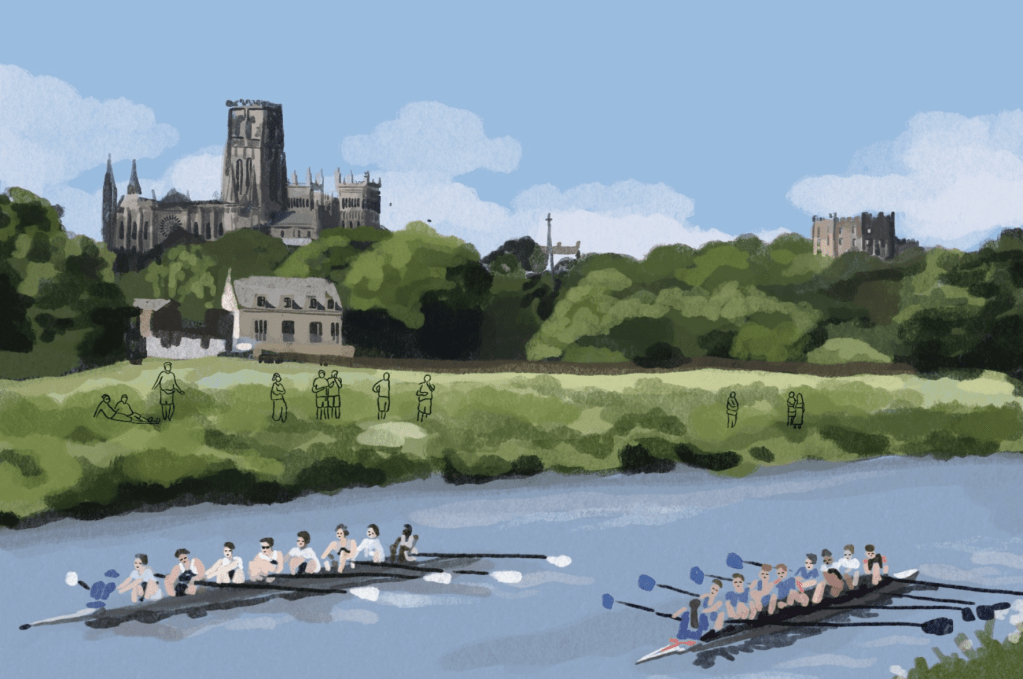
The Durham Regatta is set to take place annually on the second weekend of June – something worth marking in the calendar once exams are out of the way. The Regatta is one of the oldest competitive rowing events in the country, and one that has steadily adapted whilst retaining much of its original character.
Its official founding date is 1834, making it the second oldest regatta in the UK. But its origins go back further still; in 1815, local rowers held a procession of boats to commemorate the Duke of Wellington’s victory at the Battle of Waterloo, travelling from Prebends Bridge to Old Durham Beck. That early ritual eventually developed into organised competition. The first official race saw two six-oared crews take to the water: the Durham University Original Club, rowing in a boat named The Sylph, and Velocity, owned by W. L. Wharton, the then High Sheriff of Durham.
By 1847, Durham School Boat Club had joined the competition, and in the decades that followed, individual colleges began entering crews. Over the 19th and early 20th centuries, the Regatta developed into a fixture of the rowing calendar, attracting crews from across the region. Early races were famously chaotic, with up to nine boats starting side by side, no lane markers, and virtually no rules. Fouling was common, and crews jostled for space under the tight arches of Elvet Bridge, making it as much a test of nerve as of speed. Music, cannon salutes, and torchlit processions added to the spectacle. Over time, the event became more structured. The current two-course system – a shorter 700-metre sprint and a longer, more demanding 1800-metre course – gradually replaced the earlier upstream turns and roundabout formats, creating a modern race setup that still respects the quirks of the River Wear’s layout.
Today, the Regatta is certainly no longer a local affair. In recent years, it has hosted over 550 crews from more than 50 rowing clubs, with around 1,400 competitors taking part and roughly 250 races scheduled across the weekend. Participants range from junior scullers to veteran eights, with competitors aged anywhere from 12 to over 80. A new race sets off every two and a half minutes, keeping the river in near-constant motion. Last year’s Regatta drew more than 10,000 spectators, with crowds gathering at key points along the Wear to watch a wide variety of races, and approximately 60 trophies were awarded across the weekend.
The Regatta also plays a charitable role. Each year, certain races are run in support of local and national causes, more recently including the Great North Air Ambulance Service, St Cuthbert’s Hospice, and Row2Recovery. Clubs often nominate causes, and fundraising efforts run alongside the competition.
For those interested in a more personal take, Series 3, Episode 2 of Travels with Mum & Dad, a recent documentary by Matt Baker, is worth watching. Filmed shortly before Baker received an honorary doctorate from the University in 2025, the programme includes a visit to the Regatta and reflects on its enduring role in the life of the city. For all its history, the Regatta remains a working, evolving event – still shaped by the same river, still reliant on rowers, volunteers, and the community that turns up every June.
Of course, it would be silly to focus on any college other than our own. St John’s College Boat Club (SJCBC), founded in 1910, has been part of college life for over a century. And while John’s may be one of the smaller colleges, the club has an impressive history. In 1973, John’s became the first all-male college in Durham to admit women – and that same year, SJCBC launched its first women’s IV.
Early records for the Regatta are much trickier to find, so mentions of performances before the 2000s are unfortunately sporadic. That being said, a few key moments do stand out. A photograph in the College archive shows that in 1949, a John’s crew won the Lowe Challenge Bowl. This win came just as the Regatta resumed after the Second World War, marking an early post-war triumph for the club. The 1993 College Record notes that in 1992, the College had a successful time at the Regatta, with John’s placing second on the first day – possibly linked to the purchase of a new rowing machine that year. In 1994, a John’s men’s coxed four claimed victory at the Regatta – reportedly the first time a fours crew from John’s had done so. That win marked the start of a modern resurgence.
From the 2000s onwards, John’s has put together an impressive run. In 2009, SJCBC won the Arthur C. Clark Challenge Cup in the Intermediate 3 Eights category, setting the tone for the following year. 2010 was, by all accounts, a standout. The club brought home three trophies: the Durham City Plate (Intermediate 3 Coxed Fours), the Lady Herschell Plate (Novice Women’s Fours), and the Rushworth and Story Challenge Cup (Intermediate 2 Coxed Fours). In one of those races, John’s beat a visiting crew from A.S.R. Nereus, a well-regarded Amsterdam-based club, making this an especially proud result given the size of the club and the experience of their international opponents.
Success continued in 2013, when John’s novices teamed up with St Chad’s to win the Lowe Challenge Bowl in the Novice Eights. The crew brought the historic trophy back to John’s 64 years after the 1949 win. 2015 saw John’s take the Intermediate 2 Eights title on the Sunday of the Regatta.
Women’s crews performed well in 2022. SJCBC won the Women’s College Maiden Fours event – and notably, the final was an all-John’s affair. The crew coxed by Calcutt beat another John’s crew, coxed by Larson, to take the win, leaving both first and second place occupied by our teams.
Most recently, in 2024, John’s teamed up with Grey College to win the Durham University Challenge Trophy in the Open Non-Championship Coxed Fours, beating the other team by 2½ lengths.
Beyond the water, the Regatta still matters. The Regatta Blue Club – SJCBC’s alumni network – remains active. It connects past rowers with current crews and brings alumni back to the riverbanks during Regatta weekend. It’s not unusual to see former rowers lining the Wear, cheering on boats that feel familiar even if the faces have changed.
In the long sweep of the Regatta’s history – from cannon-start chaos and Waterloo tributes to tight bridge squeezes and university rivalries – St John’s has found its place. Whether winning by inches or ‘easily’, SJCBC continues to do well in one of Britain’s longest-running rowing traditions.
Illustration Credit: Jessica Daniels
 John's Chronicle