
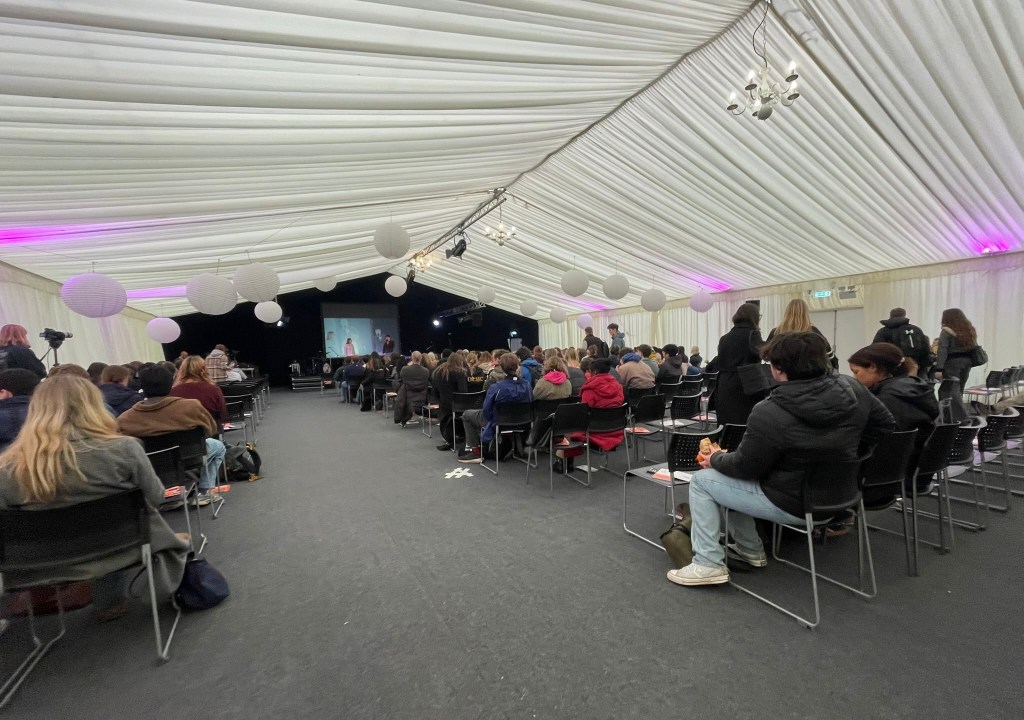
Daniel Morris reflects on attending a FOUND event hosted by the Christian Union.
FOUND was not initially encountered as a deliberate exploration of faith, but rather as a chance attendance during a busy academic week. Religion, for many students, occupies an uncertain place: familiar in outline, but distant in practice. It is often something encountered historically or culturally, rather than personally. This context shaped the experience of attending a single FOUND event.
Organised by the Christian Union, FOUND was a week of events intended to encourage students to explore and question their faith. Drawing inspiration from the line “For the Son of Man came to seek and save the lost” (Luke 19:10), the week positioned itself as an invitation rather than a declaration of belief. While FOUND spanned several days, this reflection is based on attendance at one event, offering a limited but nonetheless revealing perspective.
The event itself was informal and deliberately accessible. Rather than following the structure of a traditional church service, it consisted of a short talk followed by time for reflection and conversation. The speaker addressed the topic of ‘Science and Faith’, framing it through academics and scientists to not prove the existence of God but accept it cannot be disproven. Importantly, the speaker did not assume religious belief, he encouraged challenge and diversity in opinion.
The tone of the event was notably calm. There was no sense of urgency or pressure to commit to a particular position, and no attempt to reduce complex questions of faith into definitive answers. Instead, the focus was on reflection: on why belief matters, how it is sustained, and how it coexists with uncertainty. This approach allowed the event to function as a space for consideration rather than persuasion. It did not shy away from the contradictions of faith and honestly answered doubt.
Hesitation was addressed openly and without discomfort. Faith was not presented as certainty, but as something ongoing and, at times, unresolved. For those present, belief appeared less as a fixed identity and more as a process shaped by questioning. This challenged common assumptions that religious commitment requires absolute conviction.
Although my attendance was limited to a single FOUND event, this experience offered insight into how faith is approached in the student community. Faith is a topic I have personally battled with, yet it has never been pivotal to my life. I had gone to Church, read the Bible, sung the Songs but would not have considered myself a Christian.
Leaving the event, it did not result in any clear resolution regarding faith, but this is not the claim that was made. What it offered was a reframing of how religious spaces can operate both inside and outside of university, as an environment when conversation and debate is permitted and encouraged. For me, FOUND functioned less as a conclusion and more as a starting point.
While faith may remain distant for some, the event suggested that it need not be inaccessible. Even in the space of a single evening, FOUND demonstrated that belief can be approached critically, reflectively, and without presumption. If nothing else, it invited a reconsideration of faith not as an answer, but as a question worth engaging with.
Photo Credit: Andrew Richardson.
 John's Chronicle