
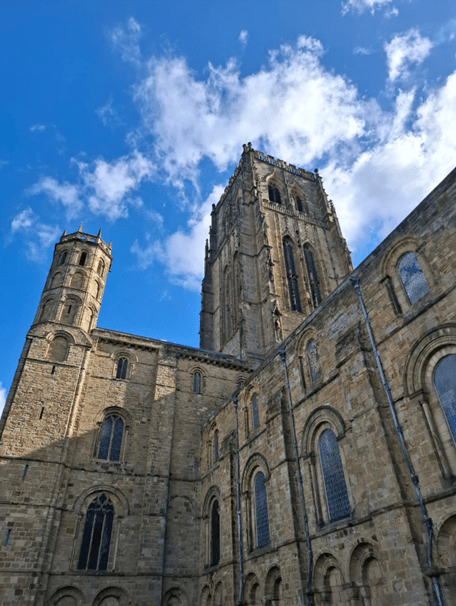
Arts and Culture Editor, Shravanee Amrute, examines the impact of Durham’s architecture on its culture, from theatre, to religion, to academic study, and ultimately on authority.
The Durham architecture contributes to the evolution of culture and education where authority exists and is shaped by artistic and academic performance. It does not just operate as a setting; rather, Durham’s architecture determines how the production of knowledge, cultural heritage and cultural value occur and are transferred and challenged.
The ensemble of the Cathedral, Castle, and Colleges establishes the long-standing connection between ecclesiastical and academic authority. The quadrangles of each site, and the processional routes between them establish the relationship amongst the worship, scholarship, and governance of intellectual labor within a religious and institutional tradition. Architectural continuity provides for the transition of the idea of universities inheriting, interpreting, and continuing to develop upon those regimes of authority, rather than being outside of that tradition.
This context shapes how cultural practices are conceived and legitimized. Palace Green functions as a curation location where events like historical interpretations and public discussions all take place in an iconic setting. Observing the layout of the buildings, we see how the buildings can also be thought of spatially, so that higher up the hill is associated with a more heightened form of the arts (i.e., library/scholarly activities, liturgy, formal performances, etc.), whereas the lower half of the valley corresponds to the more common forms of cultural expression (e.g., theatre and film venues). So, as denoted by their location, scholarship and liturgy, formal performances are all elevated to a higher status and therefore seen as the more authoritative forms of cultural expression due to their location next to the fabric of the city’s history.
Material conditions shape academic culture. The design of college courtyards, cloisters and staircases shapes how we encounter each other, who becomes a mentor and how we get access to social and intellectual capital. Architectural thresholds, such as gateways, porter lodges and entryways to buildings, provide additional security but also provide scripts for rituals regarding our identity within a college environment from beginning with matriculation through graduation that provide emotional and symbolic meaning to institutional authority. As faculty/staff and students travel through these spaces they learn implicitly about hierarchy, traditions and the validity of expert knowledge.
Durham’s architecture also serves as an important stage for the arts which both support and question this architecture. Visual elements to enhance the authority of the performances, utilising the stone vaulting, stained glass and the long reverberation times within the Cathedrals and chapels to enhance the performance to an approved level of cultural significance. In contrast, more contemporary forms of art such as exhibitions of artwork, community engagement projects or student theatrical productions which take place in areas such as crypts, side chapels or in repurposed spaces of colleges, take a much more critical approach to an individual’s history and culture; using the weight of the environment to bring into question the individuals’ history and culture that is highlighted against those that are diminished.
Consequently, Durham’s architectural landscape serves as the site where an evolution between tradition or heritage and a response to contemporary issues or innovation is developed. The particular themes of the monumental center of the city reinforce certain views regarding faith, education, and national identity, and produce a sense of authority associated with the narratives provided by these themes. However, continual recontextualization of the monumental core takes place through the lens of contemporary academic research, interpretative approaches, and often artistic approaches to create new perspectives and new histories to give life to such. In a sense, as stones, spaces, and auditory landscapes are created in a controlled environment, these physical manifestations become active agents that shape our understanding of cultural and academic life and of what knowledge is, how it is produced, and how it is represented or recognised.
Photo provided by Shravanee Amrute.
 John's Chronicle