
Thanks to the St John’s Opportunities Fund, Lilly was able to present her work on the ethical risks of PGT-P at the Fertility 2025 conference.
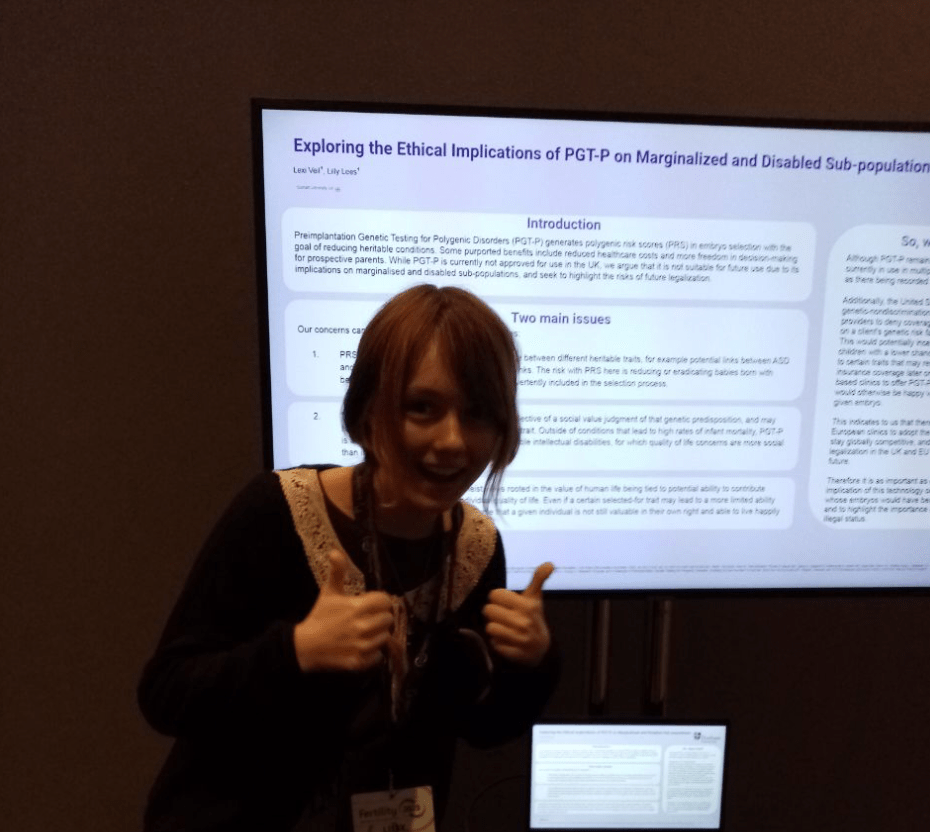
Hello, I’m Lilly, a second-year undergraduate studying Computer Science and Philosophy from St. John’s. Over the summer, a fellow student and I co-authored an abstract exploring the ethical implications of Polygenic Embryo Screening (PGT-P) for disabled and marginalised communities. Although neither of us has a biology background, we are both fascinated by the bioethics of IVF, especially given its increased commercialisation, and felt like we wanted to contribute to the critical discussion around genetic testing.
PGT-P is a type of pre-implantation genetic testing used during IVF (in vitro fertilisation). It is essentially used to assess the “risk” of a fertilised egg developing certain genetic characteristics, such as eye colour or type 2 diabetes. In practice, clinicians tend to scan for life-quality affecting traits (such as type 2 diabetes), however, more controversially (and sometimes illegally), clinicians will provide information on an egg’s disposition for superficial traits, and even IQ. This information about the set of fertilised eggs is then shown to the prospective parent(s), who decide which eggs they would like to continue with.
This is where our question comes in. We were interested in what is considered a “risk”, and on what basis? It seems like many quality of life concerns over disability are more so due to socio-economic factors. For example, the mortality rate for Autistic individuals is higher than it is for allistic individuals, however, this is due to social attitudes and structuring. However, the point about mortality rates, as well as the social connotation of disability being a deficiency, in practice leads Autism to be classified as a “risk” trait. We argue that by allowing the use of PGT-P we risk effectively eradicating those with disabilities from the IVF gene pool whilst simultaneously justifying placing the responsibility for quality of life on the individual over the society that they live in, a form of what has been called “Velvet Eugenics”.
With the generous support of the Johns Opportunities Fund, we were able to present this work at the Fertility 2025 conference in Liverpool. Although PGT-P is currently banned in the UK, pressure to legalise it is growing. In countries like the US, PGT-P is already available in some clinics and used to asses a range of traits. Because of this, we felt especially grateful for the opportunity to share our perspective with the fertility community. This was a great opportunity to not only learn more about the perspective of the medical community but also to open up a hopefully impactful discussion along the way!
Image Credit: Lilly Lees
 John's Chronicle