
Miro Cafolla reflects on a Café Théologique talk at St John’s College, where speakers explored the complex ties between faith, religion, and war.
On Tuesday, 19 February 2025, as part of St John’s Faith and Cultures week, the College proudly hosted a Café Théologique talk. Café Théologique brings together experts from various faith traditions to engage in discussions about socially relevant and sometimes controversial topics within faith and religion, with the aim of fostering peace through dialogue and mutual understanding. The event explored the complex relationship between faith, religion, and war, featuring three distinguished speakers:
- Dr Theodora Hawksley, St John’s College, Durham University
- Prof Nick Megorian, School of Geography, Politics & Sociology, Newcastle University
- Prof Jolyon Mitchell, Principal, St John’s College, Durham University
Each speaker shared unique perspectives on the question of the coexistence of war and Christianity, and the role Christian leaders play in endorsing or blessing armed forces. This seems paradoxical for a religion like Christianity, which preaches unconditional love for our neighbours and the idea of turning the other cheek.
Colombia – A Striking Example of Active Neutrality
Dr. Hawksley began by discussing the role of the Christian Church in Colombia, a country devastated by civil war since the 1960s. The conflict pits government paramilitary groups, crime syndicates, and guerrilla groups against each other. The Catholic Church has taken a stance of active neutrality, offering support to the poorest civilians caught in the crossfire, but refusing to back any of the combatant groups. This approach has allowed the Church to effectively aid local populations while maintaining respect and legitimacy from all parties involved, positioning the Church as a peace-builder and negotiator. Dr. Hawksley suggested that this example of neutrality could serve as a model for other Christian communities, urging Christians to reject war and lay down arms in alignment with the Gospel’s call for reconciliation.
Dr. Hawksley also shared a poignant insight from an Irish nun she interviewed during her research on peace and religion. The nun emphasized that even our seemingly harmless and well-intentioned choices may contribute to division and tension—what she called the “sectarian bones” we carry unknowingly. These unconscious biases can lead to discrimination and conflict, demonstrating how personal actions, whether positive or negative, can impact the broader community.
Prof. Megorian’s Global Insights on Divisions and Peace
Prof. Megorian’s presentation drew on his extensive fieldwork across the globe, from the Danish-German borderlands to Cyprus and Central Asia, with a particular focus on the Uzbekistan–Kyrgyzstan border. His research examines how human divisions are constructed, why these divisions often escalate into violence, and how conflicts can be resolved through peaceful means. During his talk, Prof. Megorian challenged the common belief that each nation has its own distinct territory and country, arguing that this idea contradicts the current geopolitical reality. While there are approximately 6,000 nations defined by ethno-linguistic categories, only 193 UN member states exist. This disparity, he explained, often leads to conflicts and tensions, particularly along national borders where diverse ethnic groups coexist.
To illustrate his points, Prof. Megorian provided compelling examples of countries fractured by conflict. He highlighted the outbreak of deadly inter-ethnic violence in Central Asia between the Kyrgyz and the vulnerable Uzbek minority. Amid the turmoil, a small group of Kyrgyz Christians rejected violence, choosing instead to help and protect their Uzbek neighbours—defying nationalist propaganda and demonstrating a willingness to risk their lives for peace and dialogue. He also recounted the 1978 maritime dispute between Chile and Argentina, which nearly led to war. In this case, the Catholic Church, under the leadership of Pope John Paul II, acted as a neutral mediator, leveraging its moral authority to broker a peaceful resolution.
Prof. Megorian reinforced Dr. Hawksley’s assertion that Christians must reject violence in all its forms. He argued that the teachings of Jesus and the letters of St. Paul make no exceptions to the call for peace. Quoting Christ’s command to “love your enemies and pray for those who persecute you, that you may be children of your Father in heaven,” he urged Christians to transcend nationalist disputes and embrace their role as peacemakers in today’s world.
Prof. Mitchell on Religion, Propaganda, and the Russian-Ukrainian Conflict
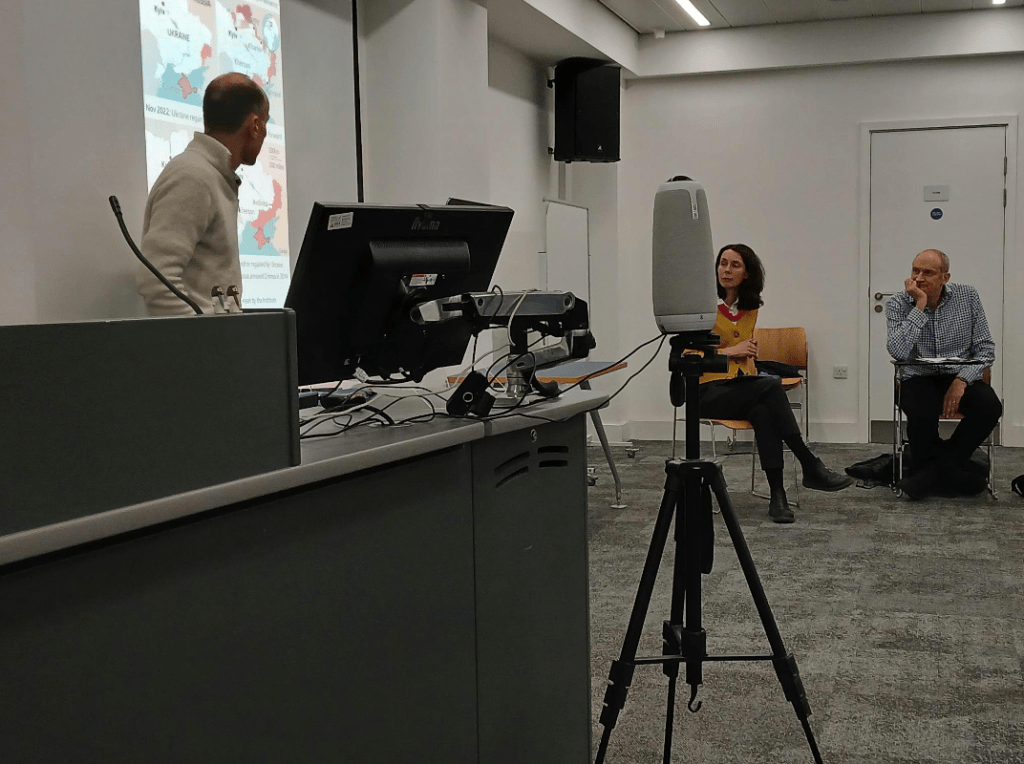
Prof. Mitchell’s presentation focused on the role of religion and religious symbols in the propaganda used by both Russia and Ukraine during the ongoing conflict, particularly from 2022 to 2025. He explained how the Russian government has built a narrative in which the Orthodox Church and the State are deeply intertwined, with the Patriarch often seen as a ministerial figure in this relationship. While not all factions within the Orthodox Church support the Russian government’s stance, Prof. Mitchell noted that the political and religious identities of Russia and its citizens are closely tied to the Moscow Patriarchate’s Orthodox Christianity.
In contrast, Ukraine’s religious landscape is more diverse. While nearly 80% of Ukrainians are affiliated with Orthodox Christianity, the country also has a significant population of Ukrainian Greek Catholics (around 10%) and smaller communities of Muslims, Jews, and Protestants. Ukraine has officially banned the activities of the Moscow Patriarchate, underscoring the religious dimension of the conflict between the two nations.
A point of divergence emerged between Prof. Mitchell and the other two speakers regarding the concept of martyrdom. Dr. Hawksley and Prof. Megorian suggested that Christian martyrs should be those who choose to die for peace, not for violence. However, Prof. Mitchell argued that martyrs could also be those who fight to protect innocent lives, a view that sparked thoughtful debate.
Conclusion: The Power of Dialogue
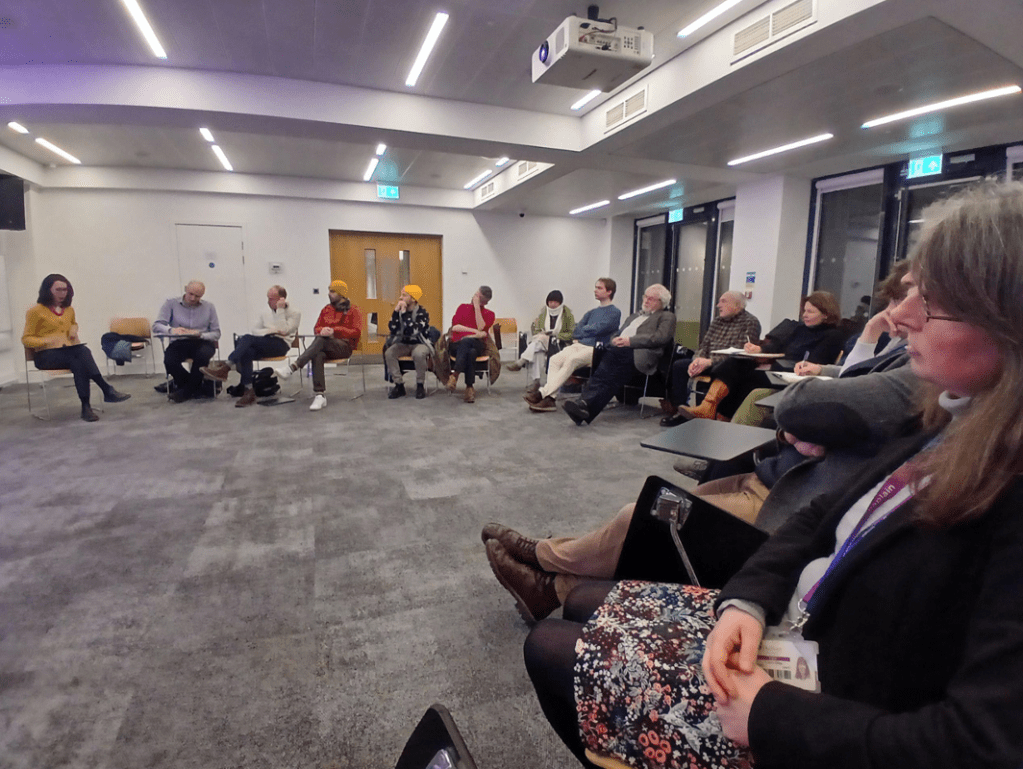
Once again, the talk underscored the power of dialogue in addressing complex issues. It was a reminder of what St John’s College does best: fostering equality, inclusion, and respect for differences while promoting understanding and peace-building across faiths.
Image Credit: Miro Cafolla
 John's Chronicle