
Thanks to the St John’s Opportunities Fund, Erica Fox was able to travel to Mexico to volunteer for a month as a field assistant.
I am a Biological Sciences student at St John’s with aspirations to become a researcher and organised an opportunity to volunteer for a month as a field assistant with an Ecology Professor in Mexico. As part of this, I was involved in helping with data collection and planning for two different research projects. I am very grateful for the St John’s Student Opportunities Fund contributing towards my travel costs, helping to get me to Mexico for this amazing experience.
Project 1: Microclimate investigation on the mountain Ixtaccíhuatl
Immediately after my arrival in Mexico I had to undergo a period of altitude acclimatisation because my first project would be at 4000m – very different from my home in the UK at 8m above sea level. This period allowed for me to explore a little bit of Mexico, aid in the planning of the field trip, and learn some of the field techniques I would be using in the field. For example, learning how to fly a drone!
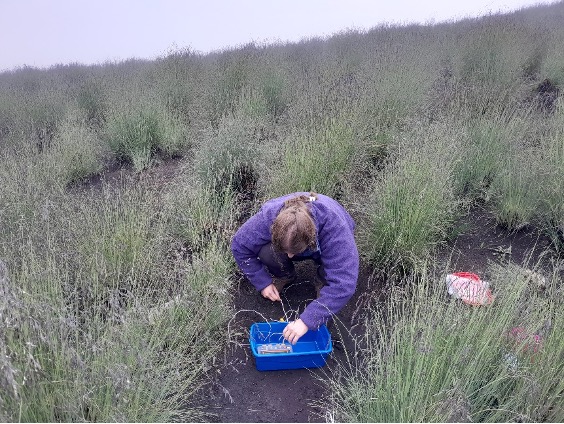
Then we drove up to the mountain, an extinct volcano, and started setting up our experiments. We were investigating the impact of frost heave (the upward movement of the soil and things in it due to ice forming) on the surrounding tussock grasses and the recruitment of new plants. We set up dataloggers around and inside small and large frost heave patches to collect thermal data and took lots of measurements of the plant species there. The rest of our experiments involved hiking to fly the drone at different altitudes to compare the sizes of frost heave patches from the images. Following my time in the field I was involved in doing initial data handling to establish a dataset from the collected data.
Project 2: Finding microscopic tardigrades in the Sierra de Juárez mountains
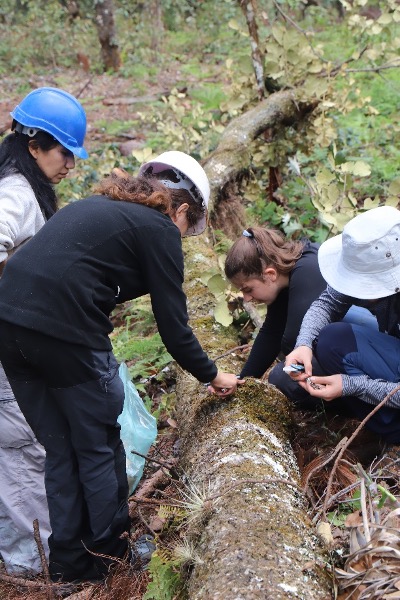
My second field expedition was to aid in the collection of moss and lichen samples from trees in the Sierra de Juárez mountains with undergraduate university students from Mexico. This was to hopefully find microscopic tardigrades (a form of animal, looking like a bear) living on them. We worked and camped with local sustainable foresters and collected samples up the length of their felled trees. It was an amazing experience to socialise with the foresters and learn more about their culture while practising my Spanish with them. I was even asked to dance!
Once we returned from the field with all the samples we collected (486), they were stored and analysis began to search for the microscopic tardigrades. I started to help with this. The sample was soaked and then the water searched under microscopes for the presence of the tardigrades. We found some of these rarely studied life forms, removed them and fixed them for future research. Little is known about tardigrades, particularly in Mexico, and this was a rare opportunity to collect them up into a forest canopy.
I learnt so many new field and lab skills while in Mexico that that will hopefully help me with future fieldwork academically, and was inspiring to set me up for my final MBiol academic/research year at Durham.
Image Credit: Erica Fox
 John's Chronicle