
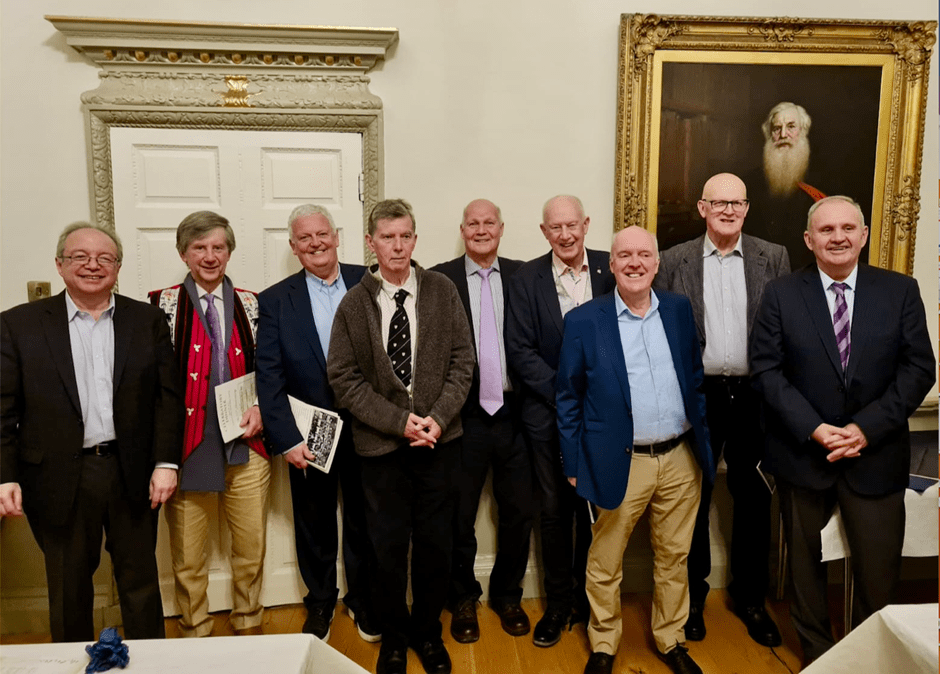
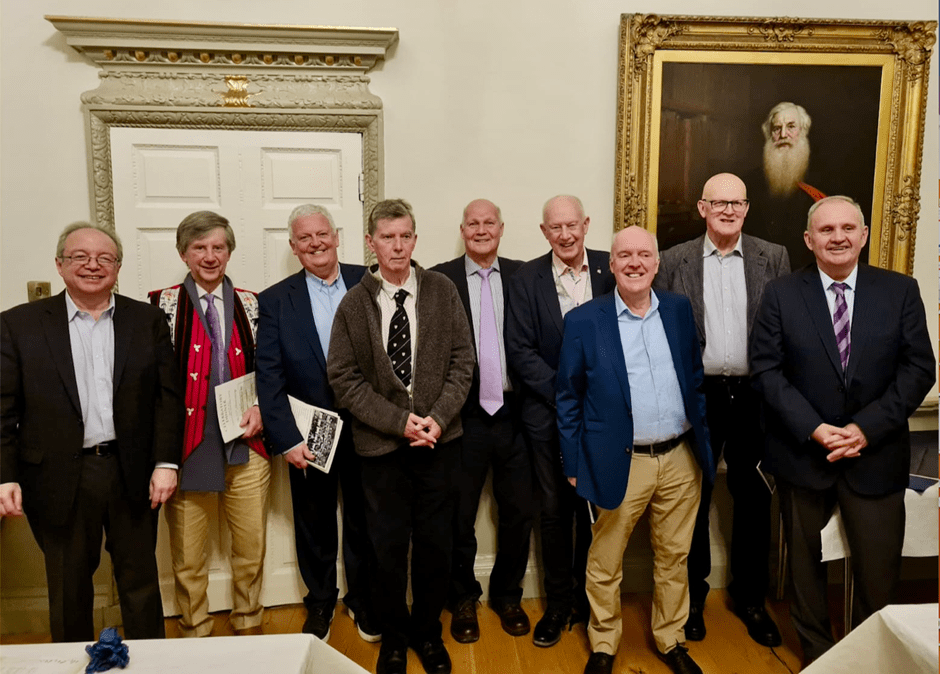
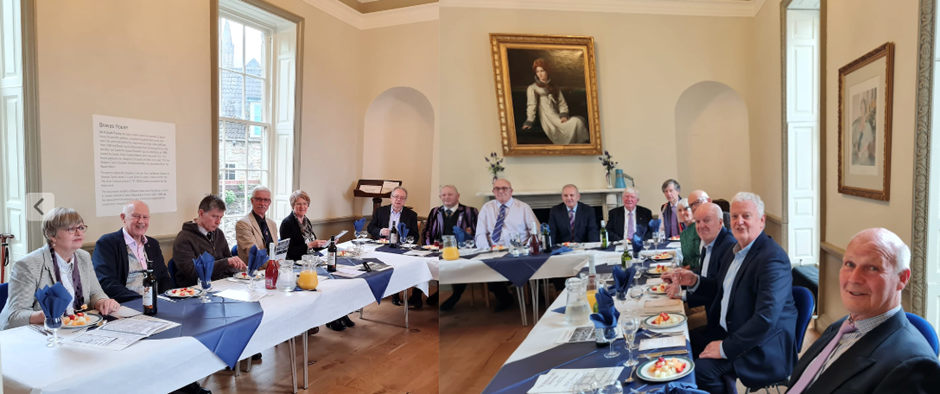
In late April, you may have seen that St John’s College hosted a reunion dinner, to mark 50 years since Durham University Men’s Hockey Team (1973-74) triumphed in the University Athletic Union (UAU) National Championships. The Chronicle sat down with a member of that team, John’s alumnus, Michael Green.
Thinking back, what made you originally apply to Durham and specifically to St John’s college?
I didn’t intend to go to John’s originally: I initially applied to Castle college. After my interview, I met an old school friend already at John’s. He shook his head woefully and said: “you do realise that Castle is the most oversubscribed college not just in Durham but across all the Oxford and Cambridge colleges!” Fortunately, John’s still had enough space for me.
As for why I chose Durham, I wanted to study ecology and Durham was the only university in those days offering an ecological option to a joint honours degree in botany and zoology. My specific interest was in large animals, inspired by Kenya’s wildlife as a child, but at Durham I was also became interested in botany thanks to the infectious enthusiasm of the likes of fungi fanatic Geoffrey Banbury, algologist Brian Whitton and David Bellamy’s passion for peat bogs, marine life, alpine pastures and much else that he featured in the BBC’s television series (Bellamy on Botany, Bellamy’s Britain and more).
What was college like back in the 1970s?
John’s was an all-male college in the early 1970s, as were Castle, Hatfield, St Chad’s, Grey and St Bede; St Mary’s, St Aidan’s, Trevelyan and St Hilde were all female colleges; and only St Cuthbert’s Society catered for mature students of either sex. Collingwood was the first purpose-built mixed-sex college founded in 1972, the same year as when the all-male Van Mildert college began taking in women undergraduates. St John’s followed suit in October 1973, my last year, with the Linton Wing having been overhauled during the summer vacation to accommodate the first tranche of ladies.
St John’s was recognised as a small, friendly college with a Christian outlook, a reputation that it continues to foster albeit the college has expanded considerably in numbers, ethnic diversity and academic disciplines. As a scientist I was somewhat isolated as most students were into the arts and humanities, with significant numbers studying theology prior to enrolling for the ministry at Cranmer Hall, a theological college in its own right that is also part of St John’s. Clearly, over the last 50 years St John’s has been renovated and expanded throughout to accommodate more students and improved facilities. The dining hall is spectacular and the cellar bar must be a welcome addition, as well as the new library on the other side of the Bailey. What I didn’t see at my otherwise very replete breakfast were the silver trays from which the bacon used to be served – not only dripping with batter but battered from being used as toboggans late at night on the snowy slopes of Observatory Hill with the maidens of St Aidans!
How did you find sport at Durham and at John’s?
I was an avid hockey player, having been introduced to the game by Kenyan Asians at Nairobi Primary School aged nine. So, I threw myself into the hockey trials during freshers’ week and, just weeks later, found myself on the annual DU men and women hockey and squash tour of Scottish universities (Edinburgh, Dundee, St Andrews and Aberdeen). It was a great way of breaking the ice and getting to know one’s teammates, both on and off the pitch, ahead of the season’s fixtures.
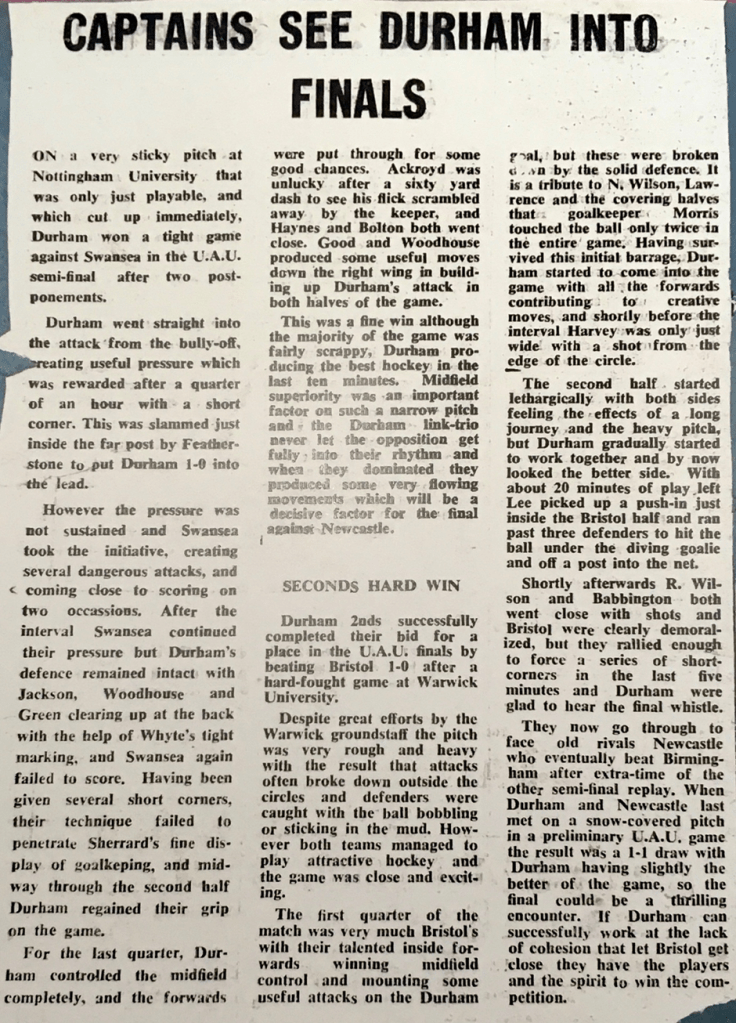
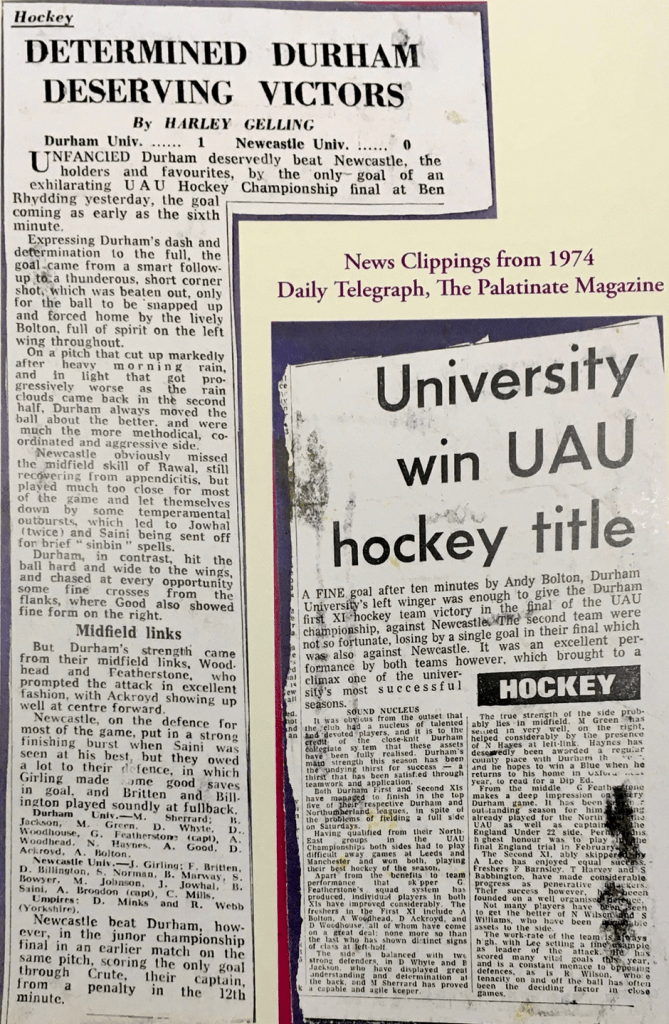
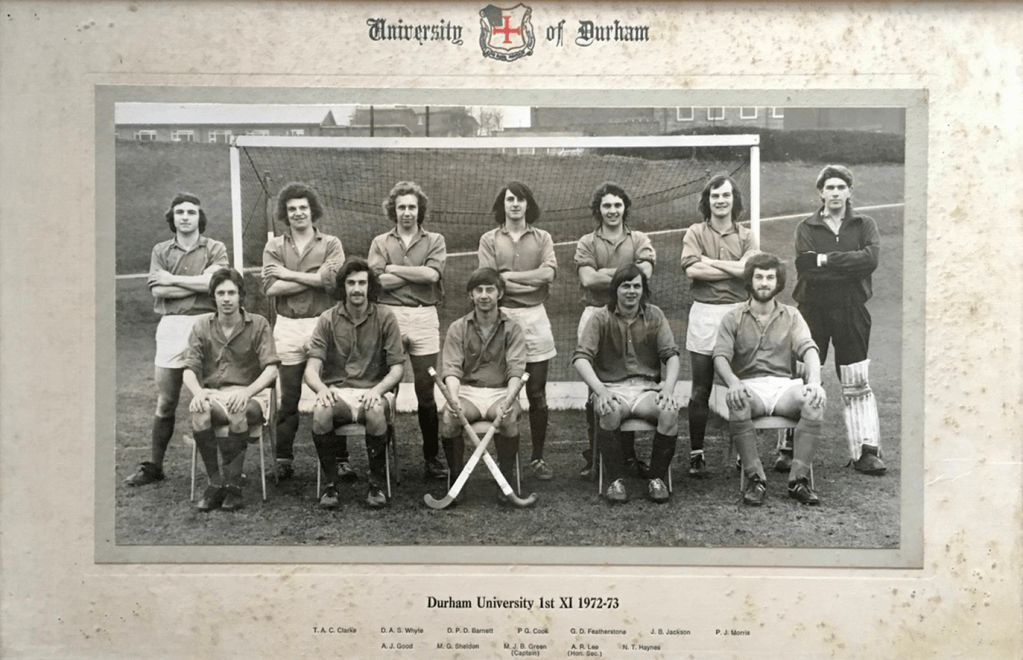
I played for the University’s 1st XI all three years, captaining in my 2nd year when we were joined by Gavin Featherstone, an England schoolboy international player who not only captained the team in my 3rd year (1973-74) but also convinced us that we could win the UAU (now BUCS) championship. We did so by a single goal secured in the first 10 minutes of the match! My abiding memory was the sodden pitch that was to our advantage as Newcastle was largely reliant on its two England forwards of South Asian heritage. Their stickwork was totally mesmerising but unfortunately the ball got stuck in the mud increasingly as the game proceeded! DU’s 2nd XI, captained by another John’s palatinate, Ant Lee, were also in the finals against Newcastle but they lost by a single goal. (Refer to the clippings for more details of the games.)
My most memorable hockey match as far as John’s is concerned was in my 1st year (1972) against Hatfield, having defied the odds and made our way to the final. Ant Lee vividly recalls the occasion:
“They [Hatfield] were bristling with top players and thought it amusing to turn up in academic gowns and treat the event with levity. But we played well and rode our luck (guided by yourself in control at centre-half!) and were, I think one-nil up half way through the second half. I had the ball near the top of the circle with just Howard Veary [Hatfield palatinate] to beat and Mike Sheldon [John’s palatinate] to my left. Howard was a fine player but not the most mobile so I slipped the ball to Mike knowing that Howard would never make the tackle. He didn’t but at the critical moment extended his stick enough to trip him as he swept past. Mike went down with a crash and did not get up: he had dislocated his shoulder.
I have lost my temper three times in my life: this was once … Veary didn’t stay at the scene of the crime. He had seen the look in my eye and he positively flew in the opposite direction to escape retribution. Eventually Mike was carried off and the game continued. We were awarded a short corner – nobody ever got sent off in those days – and I had the ball with the chance for a ping at goal. But such was my fury that I aimed not for the goal but for Veary’s knees and was pleased to see that I had aimed accurately – until I realised that I’d picked the wrong knees and hit a very nice chap called Andy Symington. Luckily the damage was not considerable. Hatfield went on to score twice and take the trophy. Howard has remained a constant friend.”
My other passion while at Durham was croquet and in my last year our St John’s team reached the final, which was held on Palace Green … so very atmospheric being surround by castle, cathedral and onlookers. Much to our chagrin, Van Mildert left the Green with trophy in hand that year!
After Durham, where did the team end up?
My wedding in 1981 was attended by a couple of the team but that was probably the last time I’ve seen the few with whom I was still in contact. At least four went into teaching, several others moved into marketing (Adidas for example) and hospitality (relocating to USA) and two of us pursued our careers as ecologists. As for Gavin, already wedded to hockey and organiser of this reunion dinner, he ended up coaching the US and South Africa teams for the 1984 and 1996 Olympics, respectively, and then returned to Durham where he headed coaching for both men and women hockey squads.
And what did you specifically get up to after graduating?
Having spent 3 formative years of my childhood in Kenya, it was my dream to become a game warden. So, after graduating, I returned to East Africa to assist a Bristol post-graduate investigate the absence of flamingos from Lake Nakuru where their food, blue-green algae, had disappeared.
Seven months later, with no further opportunities anticipated in Kenya, I joined the Durham University Himalayan Expedition, which planned to survey the newly established Langtang National Park over a 15-month period at the request of the Nepalese government. In April 1976 we set up base camp in Langtang Village (11,500 ft), tragically destroyed by an ice fall in the 2015 Nepal earthquakes, and rented half a house from the headman of the village. Whilst there, my research into the Himalayan fauna focused on Himalayan tahr, which I wrote up for a Masters degree once back in Durham.
This introduction to Himalayan large mammals led to three years studying Himalayan musk deer, this time in India’s Garhwal Himalaya. The deer is a threatened species, hunted for its musk and, at that time worth, four times its weight in gold (US¢ 45,000/kg). After completing my PhD at Cambridge University, I worked for thirteen years with the World Conservation Monitoring Centre in Cambridge, collating information on the world’s protected areas and the status of their biodiversity.
I had yet to realise my vision of becoming a park warden but in 1998 I secured a job with the Broads Authority to head up the conservation team. I soon learnt that national park management is about manging people, as the wildlife tends to look after itself given half a chance! In 2006 I decided to go freelance and have since worked throughout Central, South, South-East and East Asia, as well as several Pacific Island nations – helping governments to plan, develop and strengthen their protected area systems and to engage with neighbouring communities. I retired in 2022 and have since become involved in creating a charitable trust to purchase some ‘ancient woodland’ for our local community to enjoy and conserve in perpetuity.
Finally, have you got any advice for current John’s students?
Having recently re-established contact with one of my St John’s mates, Clive and I reflected on how our common interest, sport, inspired and fulfilled us while at university. It stretched us to our limits and grounded us in confidence, generated from the achievement of those having the same interest.
So: explore and embrace the opportunities available while at university; and, by following your gut instincts and passions, you will become an expert with inner confidence and an inspiration to others.
Finally, I would like to acknowledge Professor Jolyon Mitchell’s courtesy in joining the pre-dinner drinks party and thank all those John’s staff who contributed to the enjoyment of our reunion to celebrate our hockey triumph 50 years ago. I sense that John’s is in good, dynamic hands with inspiring times ahead!
 John's Chronicle
Just for the record, there is a mis-print in the article on DU Men’s Hockey 50 Year Reunion: the reference to “. . . and two of us pursued our careers as economic advisors” should read “. . . and two of us pursued our careers as ecologists”!
Michael Green
LikeLike