
As John’s continues to celebrate fifty years of women at St John’s, Editor Toby Donegan-Cross finds out about the reasons for and process by which college accommodation became desegregated.

The summer of 1974 was an exceptional one for newsrooms. Between Philippe Petit’s Twin Tower antics, new leaders in Argentina and Australia, and World Cup triumph for West Germany, the July and August had no shortage of things to talk about.
Above all else, however, the newscycle would be defined by one thing: the Watergate scandal and President Richard Nixon’s resignation, the climax of two year’s worth of revelations. So remarkable did the story seem that one of the journalists who spearheaded the investigation, Bob Woodward, later told of his worry that he and partner, Carl Bernstein, had “broken the news”. What, he wondered, could possibly top the scandal to top all scandals?
By quirk of coincidence, it was in the very same week that Nixon gave up his office to his deputy, Gerald Ford, that a different Nixon – this time the Revd Robin Nixon, Senior Tutor of St John’s College – realised he had his own diplomatic predicament on his hands. This was the matter of the segregation of John’s college accommodation.
Things began with a letter from the JCR president, Robert Chalmers, who, if the stamp on the fold of the letter is anything to go by, was spending his long summer break in Manchester.
“Dear Mr. Nixon”, he began. “I enclose a copy of the paper for presentation to the Council at the forthcoming meeting. The paper is brief but, I believe, contains the essence of the J. C. R.’s point of view.
“I hope that you will be able to present it in its entirety along with the other opinions to be expressed at the meeting.”
Business over with, the president signed off with an eccentric flourish. “I hope you have pleasant vacation without too many rams and the like appearing on your lawn”.
What, then, was the senior tutor was being encouraged to present to Council?
“Women have already been admitted and successfully accepted into College life”, Chalmer’s resolution began.
“The continuance of segregation against the wishes of the students could only be regarded as a negative, if not a retrogressive, approach to College life, an important aspect of which is the sharing of activities and responsibilities.”
“Furthermore”, the document continued in a mix of the moral and pragmatic, “it is of the utmost importance that the women of this college are treated as equals and not as women in a men’s college. St John’s now is and should remain a mixed College.”
To the modern reader the notion of mixed accommodation might feel trivial in the broader fight for gender equality. Yet this sense is entirely absent in the JCR’s resolution. “It only remains to stress how important it is to the future of St John’s College that progress continues to be made by settling this question of accommodation as soon as possible.”
Perhaps it is too easy to plaster over flash points of the past. But in 1974 (and as it still does), the broader issue of female equality seemed an urgent one. Bar teachers and civil servants, women were not yet legally entitled to equal pay (the act would come into force following year), while new laws propelled by second-wave feminism – allowing abortion, 1967, and no fault divorce, 1969, for instance – would still have felt very novel indeed. These were not things students could take for granted, but rather fresh rights which demanded energetic advocacy.
The second thing which may strike the modern reader is that mixed accommodation seems an uncontroversial matter. Who could be bothered to oppose it?
What becomes clear from the archive, however, is that the status quo had its defenders. “It is argued”, the resolution continued in a line replete with ‘70s innuendo, “that there are moral risks involved with the integration of college accommodation”.
Contrary to this the JCR made two points. “In the first place it must be pointed out that this risk would not be eliminated by the continuation of segregation. Secondly, and perhaps more important[sic], any moral risks are rather likely to be reduced in such a College as St. John’s with its particular traditions and type of student.”
Since women had been admitted to Cranmer Hall in 1966 (they were admitted to the undergraduate programme at John’s in 1973, making last year the fiftieth year of women at John’s), 28 North Bailey had been set aside as the college’s women-only residence. But increasing numbers quickly rendered this solution temporary, and the following year saw the Cottage and the top floor of Linton House identified as further places for self-contained, segregated corridors. In 1974, as college expected yet another increase of female students, the dingy first floor of Cruddas was earmarked for the purpose.
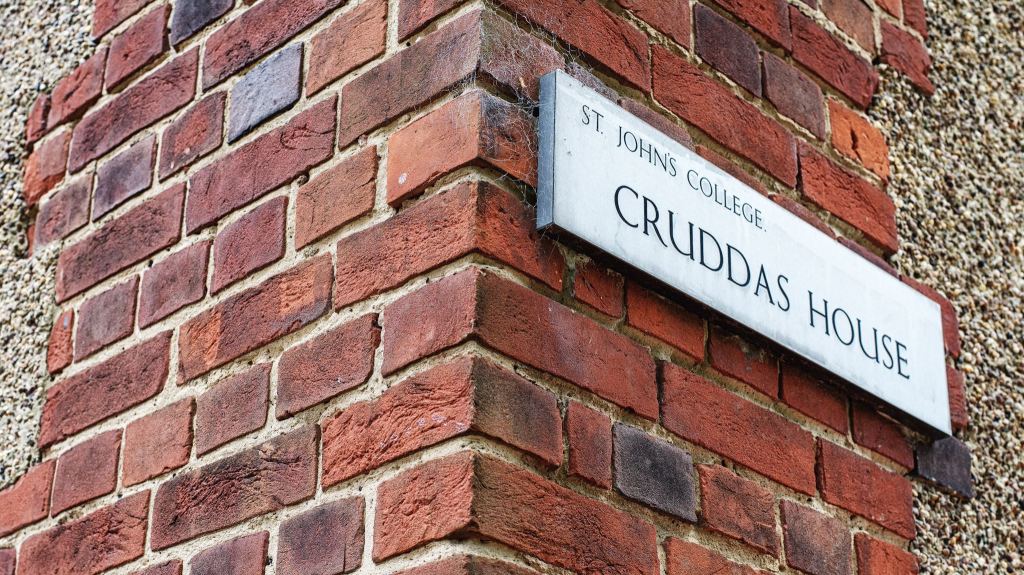
But in the end, there was no need. The council listened. In a confidential document, presumably for distribution among college leadership, Nixon expressed sympathy with the students’ argument in a diplomatic summary of the debate.
“The arguments for clusters and integration are largely concerned with breaking down artificial barriers and making sure that a mixed college is really mixed so that people can grow to maturity.
“The arguments against centre on the need, particularly for the girls, to withdraw at times and the dangers where relationships have developed and people have chosen rooms very close to each other of their becoming too much for the parties to restrain themselves or of causing very great stress when they break up.”
“The problem of image and public opinion outside”, he continued, “is not irrelevant… and a serious loss of confidence by our constituency could have disastrous results.”
Yet when push came to shove reputational concern was considered immaterial. “The proposed arrangement by the students has been carefully thought out”, he concluded, and “would give a fair distribution of doubles and singles to the girls expected for next year.”
In practical terms, this meant the following year would be a prelude, during which men and women would live in ‘clusters’ which were more intimate but not wholly integrated. The ground floor of 28 Bailey would go to men, but women would keep the first and second floors. Women would have the Butterworth’s flat of Linton House, 3 and 3a on the first floor, and 5 and 9 on the second (6 and 6a would go to men). Meanwhile, men would have the first floor of the cottage while women would have the second as well as all but three rooms on Cruddas’ first floor.
Should this prove a success, the next year would do away with these allotments, but with one notable caveat: that those who wished to live in segregated quarters would still have the option to do so.
Making this change in 1974 marked John’s as neither pioneering nor behind the curve. Van Mildert became the first to admit both men and women in 1971, while Collingwood, opened in the following year, was the first purpose-built mixed college. Others took a gentler amble towards change. Chad’s and Hatfield admitted women only in 1988, and Trevelyan men as late as 1990.
Desegregation was to be one of Revd Robin Nixon’s last acts as Senior Tutor. He went on the following year to be Principal of another St John’s College in Nottingham, before dying unexpectedly in 1978. At just 46, Nixon was survived by his wife Ruth and their three daughters. He was described in an obituary as an exemplary leader: “gentle and sensitive, humble and open” as well as “firm…purposeful… so gifted, so able and so good a friend.” Many of these qualities are unmistakeable in the correspondence surveyed for this piece.
For all that might appear parochial about an episode of common room-college politics, we might reflect that, unlike the events across the pond in ‘74, the JCR’s resolution left a more easily perceptible imprint on the future. Long term, what has changed in America on account of Watergate? Presidents still seem to imagine themselves as above the law. Accusations of electoral foul play abound. Democrats battle Republicans. Journalists anxiously chase a scoop. And so on…
In contrast, how far have the contours of college life been shaped by this double side of A4, now buried in an archive? Neighbours matter. Many become friends. Some best friends. Others wives, husbands, life partners. And how far might gender desegregation have paved the way for other integrations which have positively transformed the character of St John’s?
****
The documents referred to are in Palace Green Archive, Durham University, under the shelf-mark UND/F4/C3/A2–A3. The extract of Revd Robin Nixon’s obituary is taken from The Churchman.
Image credit: Toby Donegan-Cross.
 John's Chronicle