
Callum Hynd suggests at Lumiere we should view the city of Durham not as an exhibit hall but rather as a canvas on which artists should project their respective works.
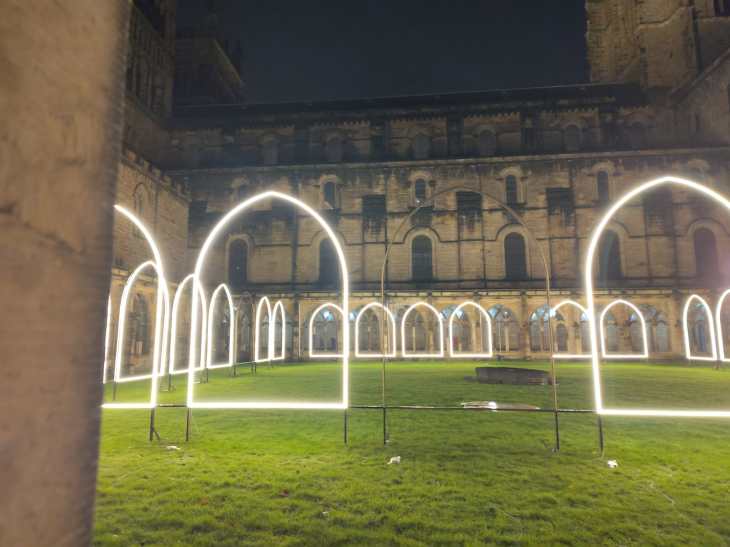
This week will see the Lumiere festival 2023, with this being the eighth time the festival has been held in Durham since it began in Durham in 2009. This year the festival will run from Thursday 16th of November to Sunday 19th and will consist of thirty-nine artworks scattered across Durham each with its own theme and artistic sensibilities. Moreover, this year’s festival has brought together a range of diverse artists and members of the local community to celebrate the festival.
The first Lumiere festival took place in Durham in 2009, finding its inspiration from the “Fete des Lumiere’s” hosted in Lyon. Since the first iteration of the festival, Lumiere has expanded significantly to become the UK’s largest light show and with the support of Durham County Council, Durham University and Arts Council England the festival has developed into perhaps the most popular art festival in the North East of England.
The festival has also been responsible for bringing significant economic success to the region with an estimated economic impact of £37 million since the festival first took place in 2009. Though the benefits of the festival are not just economic as the festival has also engaged over 12000 community participants since 2009 and thereby has developed the cultural fabric of the region.
The festival is also an important period for bridge building regarding classic Town and Gown tensions. Lumiere offers a unique chance for both students and locals of all ages to get involved whether its designing setting up or just being helpful guides to lost onlookers. As one contributing Johnian has put it, I decided to sign up to give back to the community in which we live.
A very exciting piece recommended, is the Pulse Topography in the Cathedral. An instillation made up of around four thousand lightbulbs, which can be triggered to sync with a participants heartbeat! However if you don’t feel like making the trek around Durham this year you can still enjoy the college contribution. Where chief technical intern Miles Balderson will be lighting up the college chapel in a variety of colours.
Wider ruminations
Thinking more broadly about the festival, in the art world there has been a growing trend of these kinds of festivals and exhibitions where the situating of works, exhibitions and displays respectively has quickly become a far more popular form of artistic expression and way of working since the start of this millennium. The central maxim and intention behind these festivals is to meet the public with art in public spaces and thereby inform the artistic conscience of the public and create a kind of buzz in the area.
Of course there is nothing obviously wrong with this aim, indeed I’m sure anyone reading can name at least one of these public displays of art which was to the benefit of the area. However, within the central ideology of this practice there is a clear and paternalistic strain, namely, that in a lot of cases the art which finds itself in a public space is often there without the say of the public. This lack of choice on the part of the public is also coupled with the idea that by having this art in public it is somehow serving some public good, though who decides what’s in the public good is often unclear. It is impossible to walk through any train station without catching a glimpse of some piece of work attempting to decorate the area. All this serves to reflect the tyranny of modern art which is part of our culture, with conceptual art popping up regardless of whether anyone really wants it to be there in the first place.
The second problem with these displays of artworks in public spaces is that there is a distinct problem of composition. Namely, the works of art are themselves not of the place where they are presented to the public but rather than artificially inserted into a setting where it is hard to understand what purpose they serve by being there.
This is the artistic problem that the Lumiere festival works to solve, and where the artwork of the festival really comes into its own. All the artwork presented at this years festival has not been artificially inserted around Durham in the same fashion as one would display a work in a gallery, but rather the artists involved with this year’s festival are keenly conscious of place and view the city of Durham not as an exhibit hall but rather as a canvas on which to project their respective works.
This artistic method and sensibility plus the very real economic and social benefits that the festival brings undoubtedly explain the immense success the festival has enjoyed over the years, and I’m sure will continue to enjoy in the years to come.
This year’s festival runs until the 19th November 2023 with every artwork being completely free to view, though it is important to note that free tickets must be acquired for the peak times of 16.30 – 19.30. From this period onwards, all the artworks can be seen without a ticket until 23.00 in the evening. There is also an app which can be downloaded which acts as a virtual programme and map for all the artworks displayed at the festival.
 John's Chronicle