
In the first of a two part interview, Grant Kuppenheimer talks to Professor Jolyon Mitchell about what led him to becoming Principal of St John’s College.
In the first of a two part interview, Grant Kuppenheimer talks to Professor Jolyon Mitchell about what led him to becoming Principal of St John’s College. Amidst the Bailey Ball, as I attempted to capture the livery of the event through my camera lens, I saw new and old faces of Johnians from different walks…
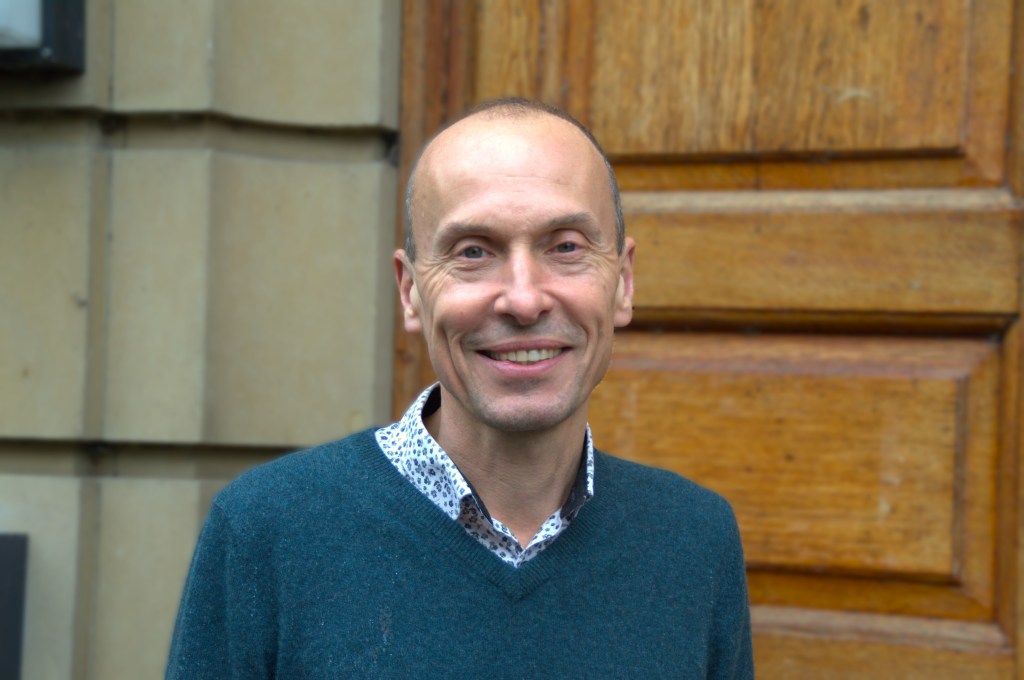
Amidst the Bailey Ball, as I attempted to capture the livery of the event through my camera lens, I saw new and old faces of Johnians from different walks of life. As I manoeuvred around the marquee, observing the many inflatable games, I saw one individual in particular who seemed a bit too old for an undergraduate yet was thoroughly enjoying himself like he was one. It was then I met our new Principal, Jolyon Mitchell.
Who was this seemingly mysterious yet highly involved professor who appeared to be part of John’s his whole life? During our conversation on Monday, Jolyon told me some of the highlights of his career, moments which cultivated his ethos of being a “peacebuilder” and personally recognising the importance of dialogue, especially amid violence. It was in Rwanda, after the 1994 genocide, that Jolyon found himself confronted with this notion of building peace. He recounted visiting sites of mass killing, at former schools, colleges and even churches. At one he was led by a local guide who had lost most of her family in the genocide, that claimed over 800,000 lives in one hundred days. Witnessing the aftermath of such barbaric violence compelled him to ask, “What can I do”? The answer he received was simple: “Tell people, so it never, never happens again.” This stark revelation led Jolyon to promote even more vigorously non-violent peacebuilding efforts.
During a year-long peacebuilding project in the so called Holy Land, he led a group of Israeli and Palestinian religious leaders and journalists to the Netherlands for an intensive week of conversations away from the conflict zone. There he gained a second insight which is influencing his approach to being Principal. At this gathering, he was surprised to see how the discussions became increasingly civil and constructive. He even became quite optimistic regarding the outcome. Yet, a sudden outburst at the conference’s final session by a Palestinian participant left him silenced. Jolyon recounts how “this delegate stands up and basically shouts, first in Arabic and then in Hebrew at the Jewish delegation: ‘We have these long conversations, these meetings and then nothing ever happens, nothing ever changes’.”
Consequently, a Jewish leader shouted back, “All I was thinking was, oh no, this is the last hour, and things have fallen apart, after a week of really constructive talks”. A tall Palestinian priest from Bethlehem managed to bring “the temperature of the room down from a 10 to about a 7, but this was not enough as the meeting concluded a few minutes later.” Jolyon felt like the dialogue ended in complete failure, but when he returned to Israel/Palestine to Jerusalem, Ramallah and Tel-Aviv, and spoke to individual members about how they had found the week, he was surprised. Jolyon was told how, despite the constructive discussions and meetings of the first four days, “the best part was the last hour when we were talking truthfully to each other”. How do you allow people to speak truthfully and teach them to “disagree well without resorting to knives, guns, and bombs”? Jolyon sees a correlation between his past peacebuilding work and becoming Principal, for one of his chief visions for the college is to further enrich this unique community as Johnians seek “to live side by side peaceably even if students and staff don’t share the same beliefs and world views”.
Although Jolyon studied at St John’s as a postgraduate, returning to the college as a Visiting Fellow greatly impressed the academic and former BBC World Service radio producer. Seeing the community “flourishing and thriving” influenced his decision to consider putting his hat in the ring for the job of Principal. Given John’s was always “very close to my heart”, after meeting about 40 to 50 people during the appointment process he concluded it was like participating in “communal vocational discernment”. For Jolyon, “the job brings together a range of my expertise and experience,” specifically, “academic, professional, and experiential parts of my life, which is exciting”. Additionally, Jolyon feels he is committed to higher and collegiate education as the son of an academic and theatre director-actress, as well as the father of three, with two children currently at university.
In fact, it is partly due to the collegiate system that Jolyon loves John’s so much. Unlike in many other universities, students are not “lost among over 20,000 students but are invited to participate in an extended community with a family feel of around 800 students”. For Jolyon the bringing together of different disciplines is extremely enriching and rewarding. John’s allows students to be part of a “community of learning” that, being situated on and next to a World Heritage Site, that “has functioned as a place of study and worship for over 1000 years”. The diverse college environment of learning grants students the ability to be cross-disciplinary, learning from a range of academic backgrounds, and inter-disciplinary which can change the way you think about your area of study; Jolyon strongly feels that a college like John’s is uniquely placed to facilitate such an environment”.
Jolyon’s prior commitment to John’s and the collegiate system guided his decision to accept the position of Principal “when the head-hunters came knocking”, bringing his highly unique perspective as an academic peacebuilder. In the second part of my interview, I will explore Jolyon Mitchell’s plans and vision for the college, especially his commitment to help make John’s the friendliest college in Durham.
 John's Chronicle